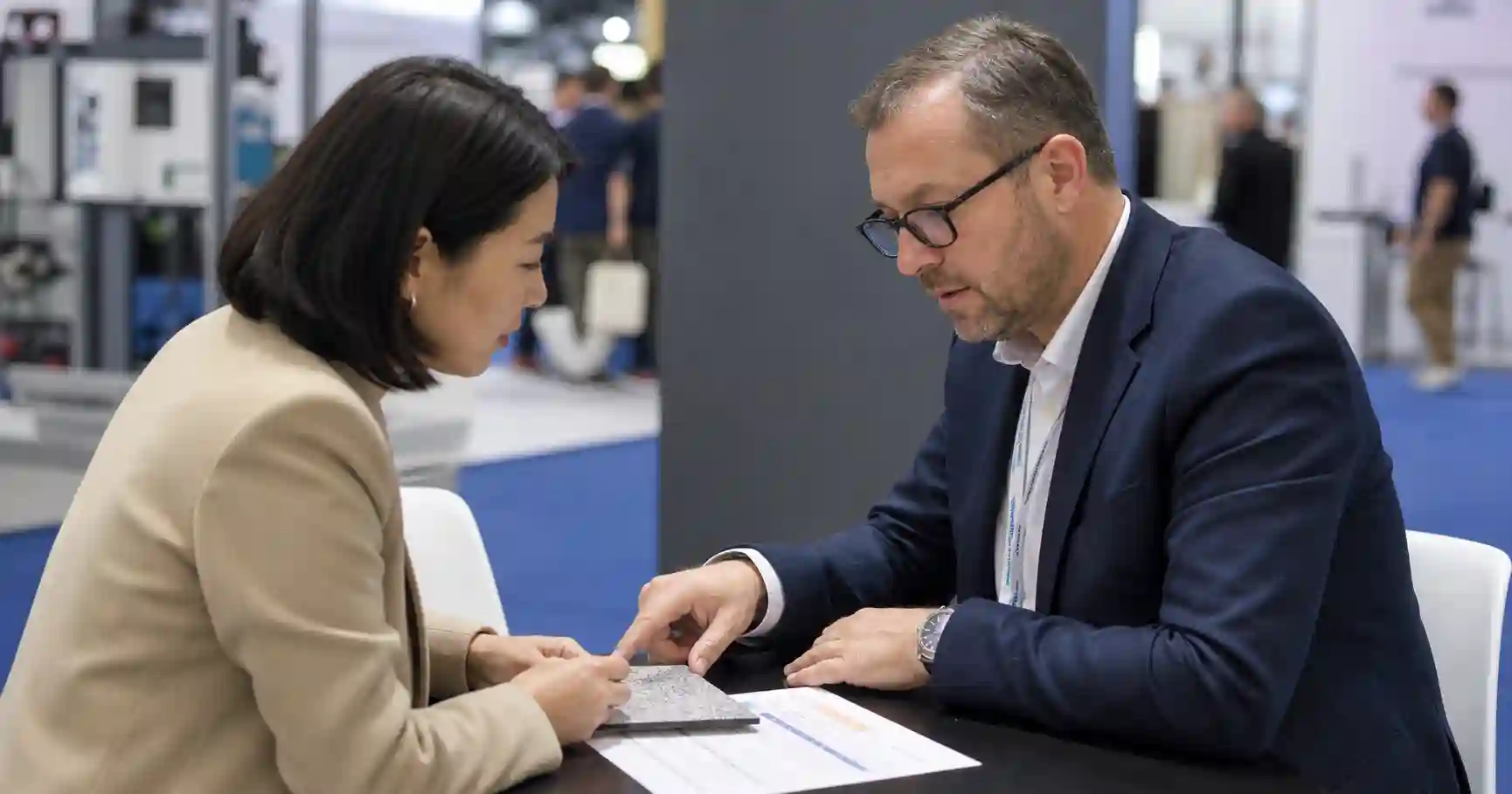
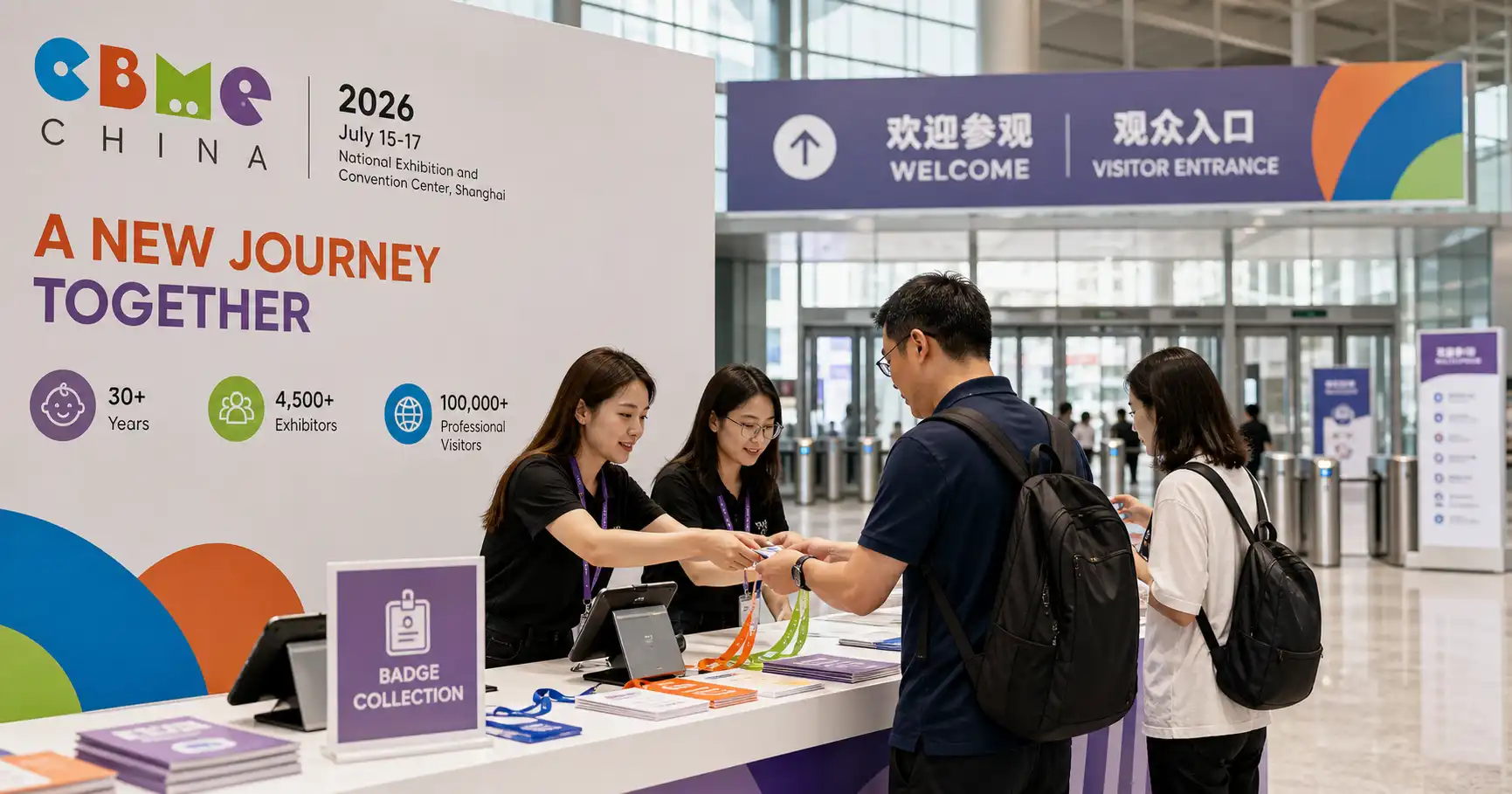
Before placing an order with a baby product supplier in China, ask targeted questions across seven categories: product specifications, pricing and terms, customization options, compliance and certifications, sample process, packaging and labeling, and logistics and after-sales support. CBME China 2026 (July 15–17, NECC Shanghai) gives buyers three days to run these questions against multiple suppliers in person—often more productive than weeks of email exchanges.
Use this checklist to structure your supplier conversations before the show. Download the monthly Product Spotlight to shortlist exhibitors and prepare category-specific questions before CBME China 2026 opens.
CBME China 2026
- Date: July 15–17, 2026
- Venue: NECC Shanghai (National Exhibition and Convention Center)
- Categories: Baby & maternity, toys & education, food & nutrition, gear & furniture
- Register: Register to Visit
Why the Right Questions Prevent Costly Mistakes
Most sourcing failures share a common cause: buyers did not ask enough questions before committing. Unclear specs lead to wrong products. Unverified certifications cause customs holds. Missing packaging details create rebranding costs. Vague lead times disrupt retail calendars.
A structured question checklist solves this. Group your questions by topic so you cover every decision point without forgetting critical areas. Use the same checklist at every booth to compare answers consistently. When you have 8–12 supplier conversations over three days, standardized notes become your competitive advantage.

Product Specifications and Capability
Start with questions that confirm the supplier can actually make what you need.
- What product categories do you specialize in? Match their core category to your target product.
- Do you manufacture in-house or use subcontractors? In-house production gives you more quality control; subcontractors require additional vetting.
- What is your minimum order quantity per SKU? MOQ varies widely—some factories require 2,000 units per colorway, others accept 500.
- Can I see samples of similar products you have produced for export markets? Export samples show quality baseline and packaging standards.
- What is your production capacity per month? Capacity tells you whether they can meet your volume and lead time.
- Do you have R&D or engineering capability for custom modifications? ODM suppliers with R&D teams can adapt existing designs faster than pure-OEM factories.
Pricing, Payment Terms and Commercial Clarity
Commercial questions reveal whether a supplier is transparent and organized.
- What is your pricing structure? Can you provide a quotation for my target quantity? Get itemized pricing, not just a total.
- Do you offer price breaks at higher volumes? What are the tiers? Common tiers: 1K, 3K, 5K, and full-container quantities.
- What are your standard payment terms? Industry norms include 30% deposit, 70% balance before shipment.
- What currencies do you accept? USD, EUR, and CNY are common; confirm before negotiations.
- Do you work direct to overseas buyers or through trading intermediaries? Some factories only sell through trading companies.
- Are there additional costs I should budget for—tooling, moulds, inner packaging, labeling? Ask for a full-cost breakdown upfront.
Customization and OEM/ODM Options
Customization questions determine whether the supplier fits your brand requirements.
- What customization options do you offer for this product category? Colors, materials, sizes, prints, and features all vary by factory.
- What is the process for OEM manufacturing to your own design? Confirm tooling ownership, engineering review, and sample approval workflow.
- Can you produce under our brand with neutral or custom packaging? Verify what branding elements they can support.
- What are the customization MOQs? Do they differ from standard orders? Custom colors or materials often carry higher minimums.
- How long does customization add to the standard production lead time? Factor this into your retail calendar.
Compliance, Certifications and Quality Assurance
Compliance questions protect your market access and brand reputation.
- What certifications do you hold for your export markets? Key certifications include CE (Europe), CPSIA (USA), GCC (Gulf), and CCC (China).
- Can you provide test reports for my specific target market? Request third-party lab reports, not just factory declarations.
- Do you have a documented quality management system? ISO 9001 or similar certification indicates systematic processes.
- What is your policy on pre-shipment inspection? Third-party inspection (SGS, Bureau Veritas, or similar) adds cost but reduces risk.
- Do you have experience with regulatory requirements for baby products in your target market? Baby products face stricter regulations than general consumer goods.
- Can I visit your factory before placing a formal order? Factory visits remain the most reliable due diligence step.

Sample Process and Product Approval
Samples bridge the gap between specifications and actual product.
- What is your sample policy? Is sample cost refundable against a first order? Most factories charge sample cost plus shipping; refundability varies.
- How long does it take to produce a sample? Typical range: 7–21 days depending on complexity and factory queue.
- Can you produce a golden sample for our approval before bulk production? Golden sample sign-off prevents production disputes.
- Will samples be representative of bulk production quality? Request pre-production samples from the same production run when possible.
- How many samples should I order to evaluate properly? Order samples of different colors, sizes, or variants if applicable.
Packaging, Labeling and Market Requirements
Packaging questions prevent surprises that cost money and time.
- What packaging options do you offer? Blister cards, window boxes, polybags, and gift sets all have different costs and MOQs.
- Can you handle bilingual or market-specific labeling? Labels must meet destination-country language and regulatory requirements.
- Do you have experience with retail-ready packaging for major chains? Major retailers have specific barcode, size, and labeling specifications.
- What are your standard export packaging specifications? Carton dimensions, master pack quantities, and palletization affect shipping costs.
- Can you accommodate barcodes, QR codes, or RFID tags? Traceability requirements vary by retailer and market.
Logistics, Lead Times and After-Sales Support
Logistics questions complete the cost picture and set post-order expectations.
- What is your standard production lead time from order confirmation? Standard lead times range from 30 to 90 days depending on product and factory workload.
- What are your peak season capacity and lead time windows? Peak season (October–January) often adds 2–4 weeks.
- What incoterms do you offer? FOB, CIF, DDP, and EXW each allocate shipping costs differently.
- Do you work with freight forwarders or can you recommend logistics partners? Some factories have preferred shipping partners with volume discounts.
- What is your after-sales or defect policy? Confirm replacement, repair, or credit processes for quality issues.
- Who is my dedicated contact after the order is placed? Clear accountability prevents order status gaps.
How to Use These Questions at CBME China 2026
Combine this question checklist with the 7-point supplier scorecard from Day 29 to create a complete pre-show preparation system.
Before the show
- Download the Product Spotlight and flag exhibitors by product category
- Build a shortlist of 15–20 suppliers you want to approach
- Prepare category-specific question subsets—for example, prioritize compliance questions for food and nutrition suppliers, packaging questions for private label buyers
- Plan a 3-day sourcing itinerary to maximize booth coverage
During the show
- Run your 20-minute booth evaluation using the Day 29 scorecard
- Ask your prepared questions from the relevant categories
- Photograph product samples and booth cards (with permission)
- Record answers immediately—carry a notebook or use a standardized scoring app
After the show, use our supplier follow-up guide (Day 43) to convert booth conversations into orders.
After the show
- Compare answers across suppliers using your notes
- Request samples from your top 3–5 candidates within one week
- Follow up with specific questions that arose during booth conversations
- Download the trade show sourcing guide (Day 34) for additional best practices
Frequently Asked Questions
Should I ask the same questions to every supplier?
No. Tailor questions to each category. Ask detailed compliance questions to food and nutrition suppliers, focus on packaging and labeling for private label orders, and prioritize customization scope for OEM projects. Keep your core commercial questions (MOQ, lead time, payment terms) consistent across all conversations so you can compare fairly.
How many questions should I ask in a single booth conversation?
Focus on 5–8 questions per meeting. You have 15–20 minutes at most booths. Quality of answers matters more than quantity of questions. Prioritize questions where the answers are hardest to verify by email—capability fit, sample quality, communication responsiveness.
What questions should I ask first at any booth?
Start with three qualifying questions: Do you manufacture this product in-house? What are your MOQ and lead time for this category? Can you show me a sample similar to my target product? If the answers do not match your requirements, thank the supplier and move on.
Is it appropriate to discuss pricing at a trade show?
Yes, but keep pricing discussions at a high level. Ask for a quotation outline, not exact numbers that require engineering review. Deeper pricing negotiation belongs in post-show email exchanges after you have compared alternatives and received formal quotes.
When should I request samples versus placing a trial order?
Request samples from any supplier you consider seriously. Samples cost money but protect against larger losses. A trial order (small MOQ order) makes sense only after sample approval and before scaling to full container quantities.
Official Sources
Related Articles
- How to Evaluate OEM and ODM Suppliers at a Trade Show (Day 29)
- Baby Product Compliance and Quality Checks Before Sourcing in China (Day 28)
- How to Source Baby Products from China: A Guide for Global Buyers (Day 4)
- Baby Products OEM/ODM in China: Private Label and White Label Guide (Day 6)
- CBME China 2026 Product Preview: How Buyers Can Shortlist Suppliers (Day 9)
- How to Find Reliable Baby Product Suppliers at CBME China 2026 (Day 5)
Published by CBME China Editorial Team
Last reviewed: July 8, 2026 | Published: July 8, 2026 | Publisher: CBME China, a division of Informa
Ready to meet your next supplier? CBME China 2026 runs July 15–17 at NECC Shanghai. Download the Product Spotlight, prepare your question checklist, and register to visit before July 10. Register to Visit CBME China 2026