Private Label Baby Products in China: What Retailers Should Know
Private label baby products are items manufactured by a third-party factory but sold under your own brand name. The concept sits on a spectrum: at one end, white label means buying generic products with minimal customization; at the other, a full OEM (Original Equipment Manufacturer) arrangement where you specify every detail from materials to packaging. Between those poles, ODM (Original Design Manufacturer) factories offer ready-made designs you rebrand — the fastest path from concept to shelf.
For baby product retailers, private label solves three persistent challenges. First, it delivers category exclusivity — a private label diaper or baby skincare range cannot be compared directly against the same product sold by three competing retailers. Second, it improves margin control — without a brand-name premium to protect, you negotiate pricing directly with the factory. Third, it enables category depth: you can build an entire private label ecosystem — feeding, skincare, sleep, travel — that no single branded supplier could offer.
The baby and maternity category is particularly well-suited to private label. Parents are deeply brand-conscious about what touches their child’s skin, sleep surface, or food — which means they are also willing to stay loyal to a retailer brand that demonstrates quality and transparency. SourceReady’s 2025 buyer survey confirmed that safety compliance, material quality, and certification transparency are now the three factors parents prioritize most in baby products — all areas where a well-managed private label program has direct control.
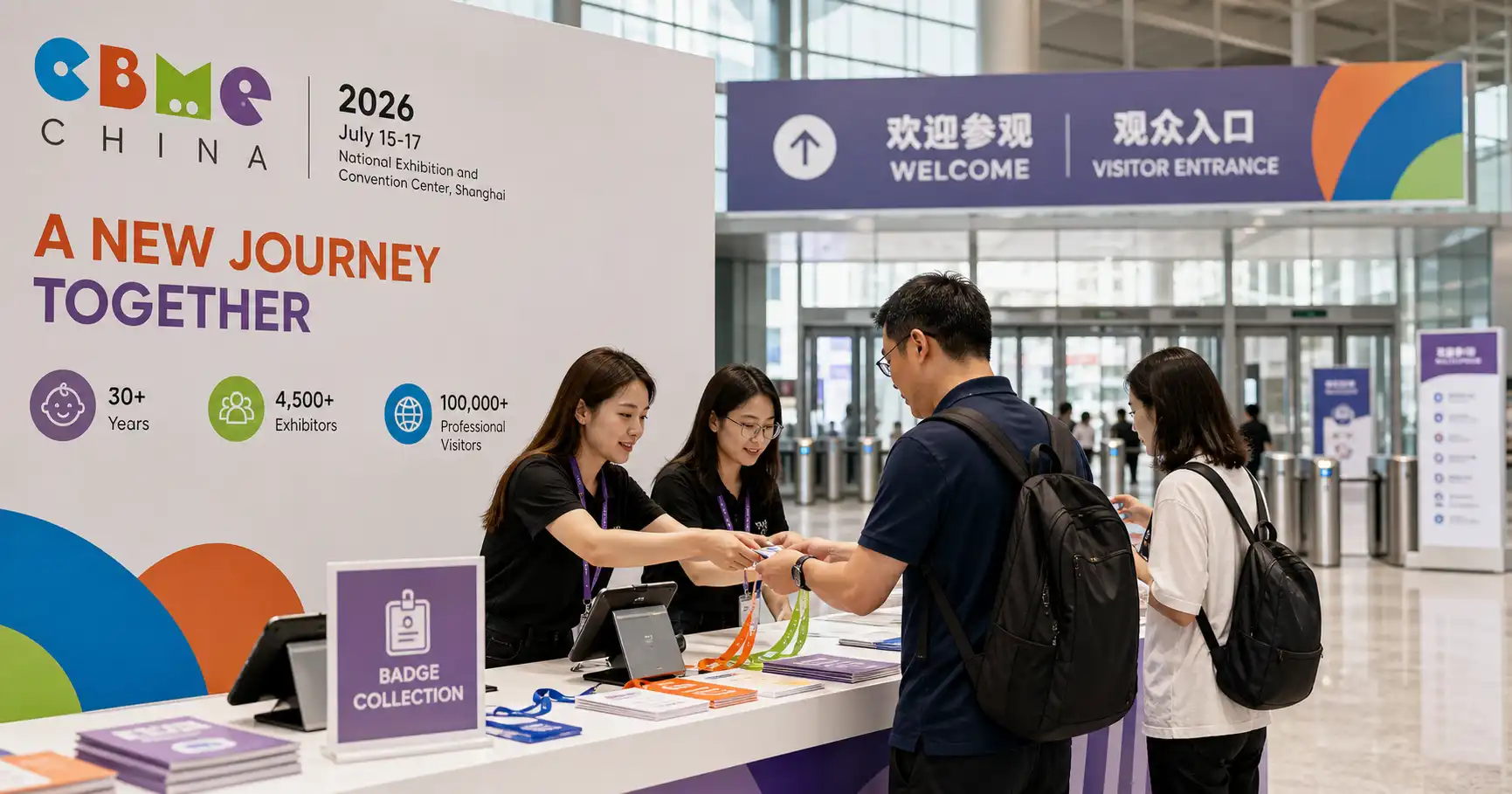
CBME China 2026
- Date: July 15–17, 2026
- Venue: National Exhibition and Convention Center (NECC), Shanghai
- Concurrent Events: CBME Toy & Education Expo, CBME Children’s Wear Expo, CBME Food & Health Expo, CBME Supply Chain Expo, Licensing Expo China
- Register: Free pre-registration — waive the RMB 100 walk-in fee
Why China Remains the World’s Top Private Label Manufacturing Hub
China has held its position as the world’s leading baby product manufacturing base for more than two decades. The country offers an unmatched combination of scale, speed, and specialization that no other single market can replicate at comparable cost.
Three manufacturing regions define China’s baby product landscape:
- Yiwu (Zhejiang): The world’s largest small commodity market, Yiwu dominates high-volume, cost-competitive production — particularly for accessories, feeding items, and travel essentials. Suppliers here typically offer low minimum order quantities (MOQs) that suit smaller retailers and e-commerce sellers beginning their first private label run.
- Guangzhou (Guangdong): The southern manufacturing powerhouse is home to more advanced production facilities with higher quality standards. Guangzhou factories tend to hold international certifications — SGS, Bureau Veritas, TÜV — making them better suited for retailers targeting the EU, North America, or other regulated markets. Lead times are longer, but quality consistency is significantly higher.
- Quanzhou (Fujian): Known for baby clothing, footwear, and textile-based products, Quanzhou gives retailers access to fabric expertise and seasonal production cycles that align with Western retail calendars.
At CBME China 2026 (July 15–17, NECC Shanghai), all three regions are represented across the exhibition halls. The CBME Supply Chain Expo, running concurrently, brings packaging, washing and care OEM, and paper hygiene OEM suppliers into direct contact with product buyers — a critical advantage for retailers building a private label line where packaging quality directly affects perceived value and shelf appeal.
Which Baby Product Categories Are Best for Private Label?
Not every baby product category makes equal sense for private label. The strongest candidates share three characteristics: high purchase frequency, strong retailer brand association potential, and manufacturing complexity that rewards scale.
The five most reliable private label categories:
- Baby Skincare and Hygiene — Lotions, baby washes, diaper creams, and wipes are ideal for private label because formulation can be customized to retailer standards (fragrance-free, organic-certified, sensitive-skin formulas) while packaging does the brand-building work. The CBME Product Spotlight monthly download is a useful pre-show tool for identifying certified skincare exhibitors before you arrive.
- Diapers and Wipes — High-volume, high-frequency purchases with strong shelf-presence value. Leading Chinese manufacturers have invested in eco-friendly production lines (biodegradable materials, bamboo fiber cores) that allow retailers to differentiate on sustainability without sacrificing cost competitiveness.
- Infant Nutrition and Feeding — Private label infant formula, complementary foods, and feeding accessories (bottles, sterilisers, breast pumps) appeal to parents who trust a retailer with their broader baby purchases. Note: Nutrition products face the strictest compliance requirements in every destination market — verify certifications before committing to a supplier.
- Children’s Clothing and Footwear — Textile private label is one of the most established OEM categories in China. CBME Children’s Wear Expo runs alongside CBME China, giving apparel retailers access to seasonal fabric collections, sizing expertise, and embroidery or print customization services in a single venue.
- Baby Gear and Travel Products — Strollers, car seats, cots, and high chairs have high unit costs and strong brand association — making them attractive for private label when the manufacturing partner holds the required safety certifications for your target market.
Download CBME China Product Spotlight

Understanding MOQs, Costs, and the Economics of Private Label
One of the most common questions retailers ask before committing to private label is: what does it actually cost, and what are the minimum orders?
There is no single answer, because costs vary by product category, factory tier, and customization level. However, a reliable framework applies across categories:
- Unit cost vs. tooling investment: Simple products (wipes, accessories) typically carry low unit costs but may require custom molds or packaging dies. Complex products (strollers, car seats) require higher tooling investment upfront in exchange for lower per-unit pricing at scale.
- Minimum order quantities (MOQs): Entry-level suppliers in Yiwu may accept MOQs as low as 500–1,000 units per SKU. Premium factories in Guangzhou typically set MOQs of 2,000–5,000 units. Always negotiate — factories often reduce first-order MOQs in exchange for a longer-term commitment.
- Certification costs: Testing and certification for destination markets (CPSIA for USA, EN71 for Europe) can add 10–20% to the first-order cost. Budget for this separately from product pricing.
- Lead times: Standard production runs are 45–90 days from sample approval to delivery, depending on factory location and order size. Factor this into your retail calendar — a private label line launched in October needs production confirmed by July at the latest.
Packaging, Labeling, and Brand Presentation
Packaging is where private label becomes brand strategy. For baby products, parents make purchasing decisions at the shelf — physical or digital — and packaging quality directly signals product quality.
Chinese factories offer a range of packaging customization:
- Structural design: Box, pouch, blister, tube — each has cost, shelf-presence, and functionality trade-offs
- Material sourcing: Sustainable options (recycled cardboard, plant-based inks, biodegradable plastics) are increasingly available from Chinese suppliers, though they carry a price premium
- Labeling compliance: Your label must meet destination market requirements — English-language ingredients, country of origin, importer details, age warnings, and certification logos all need to be verified before production
The CBME Supply Chain Expo is the dedicated zone for packaging suppliers. Visit this section with your label specifications ready to compare materials and obtain samples.
Compliance: The Non-Negotiable Step
For baby products, compliance is not optional and it cannot be delegated entirely to your factory. You carry the legal responsibility for what reaches your customers.
For the United States market
- The Consumer Product Safety Improvement Act (CPSIA) requires third-party testing by a CPSC-accepted laboratory for all children’s products
- A Children’s Product Certificate (CPC) must accompany every shipment
- From July 8, 2026, all CPCs must be submitted electronically via the CPSC eFiling system — plan your certification timeline accordingly
- Key standards: ASTM F963-23 for toys, plus category-specific requirements for feeding items, sleep surfaces, and car seats
For the European market
- EN71 is the primary toy safety standard
- REACH regulations govern chemical restrictions — particularly for items that contact skin
- Product must carry CE marking before entering the EU market
General compliance principles (all markets)
- Request test reports tied to your specific SKU and production batch — not generic sample reports
- Confirm that material substitutions during production trigger a new testing cycle
- Your Chinese supplier’s existing certifications do not automatically transfer to your private label product — each batch may require fresh testing
For retailers entering the private label space for the first time, a sourcing agent with baby product compliance experience can be a cost-effective investment. They can oversee testing, translate lab reports, and manage communication between your team and the factory.
Finding Private Label Suppliers at CBME China 2026
CBME China is the most efficient single venue for private label supplier discovery. In three days at NECC Shanghai, you can meet factories from Guangzhou, Yiwu, and Quanzhou that you would otherwise need weeks of travel to visit individually.
How to prepare before the show:
- Download the CBME Product Spotlight — this monthly PDF previews exhibitor product lines and capabilities, letting you shortlist suppliers before you arrive
- Identify your target categories from the official CBME exhibitor directory
- Prepare a supplier comparison checklist: production capacity, certifications held, sample lead time, OEM/ODM capability, export experience by market
- Use CBME’s Matchmaking Service to arrange 1-on-1 appointments with priority suppliers
Questions to ask every private label supplier:
- Do you hold certifications for my target market (e.g., CPSIA, EN71, CCC)?
- Can you provide batch-specific test reports, not just sample reports?
- What is your production capacity per month?
- Do you offer OEM, ODM, or both?
- What are your MOQs for first orders vs. repeat orders?
- Do you have a dedicated compliance or QC team?

How CBME China Supports Your Private Label Journey
CBME China is designed to serve private label buyers at every stage — from first exploration to long-term supplier partnership.
The CBME Product Spotlight monthly download gives you advance visibility into exhibiting suppliers’ new product lines and manufacturing capabilities. For private label buyers, this means you can identify and research potential partners before you step onto the show floor — maximizing your time with serious suppliers and reducing time spent with unsuitable options.
The CBME Supply Chain Expo brings the upstream supply chain — packaging materials, labeling, ingredients, equipment — into the same venue as product manufacturers. For private label buyers, this vertical integration means you can negotiate product and packaging simultaneously, shortening the path from concept to production.
The Hosted Buyer Program offers qualified buyers one-on-one matchmaking appointments with pre-vetted suppliers. If your organization is sourcing across multiple private label SKUs, the matchmaking service can compress weeks of outreach into a single afternoon at the show.
Frequently Asked Questions
What is the difference between private label, white label, OEM, and ODM?
White label refers to generic, off-the-shelf products sold without customization. Private label means the retailer brands the product with their own label — a deeper level of customization. OEM (Original Equipment Manufacturer) means the buyer specifies the product design and the factory manufactures to those exact specifications. ODM (Original Design Manufacturer) means the factory provides the product design, and the buyer adds branding and minor customizations. OEM offers the most control; ODM offers the fastest time-to-shelf.
What is the minimum order quantity for private label baby products in China?
MOQs vary by factory tier and product category. Entry-level suppliers in Yiwu may accept orders starting at 500–1,000 units per SKU. Premium factories in Guangzhou typically set MOQs of 2,000–5,000 units. Always negotiate — factories often reduce first-order MOQs in exchange for a commitment to repeat business. Clothing and footwear private label programs may have different MOQ structures based on fabric runs and seasonal minimums.
How do I ensure compliance for baby products imported from China?
Compliance is a shared responsibility between you and your supplier. For the US market, CPSIA requires third-party testing by a CPSC-accepted laboratory and a Children’s Product Certificate for every batch. From July 8, 2026, all CPCs must be submitted via the CPSC eFiling system. Request batch-specific test reports (not generic sample reports) and verify that material substitutions trigger a new testing cycle. For EU-bound products, EN71 and REACH compliance is mandatory before CE marking. Working with a sourcing agent experienced in baby product compliance is strongly recommended for first-time private label buyers.
Which baby product categories are most profitable for private label?
Baby skincare, hygiene products (wipes, diapers), feeding accessories, and children’s clothing consistently show strong private label performance because of high purchase frequency, strong retailer brand association, and clear opportunities for differentiation through formulation or material quality. Baby gear (strollers, car seats) offers high unit value but requires higher tooling investment and stricter safety compliance. Prioritize categories where your target market demonstrates loyalty to retailer brands.
How does the CBME Supply Chain Expo support private label buyers?
The CBME Supply Chain Expo runs concurrently with CBME China and covers packaging materials, labeling, food ingredients, washing and care OEM, and paper hygiene OEM. For private label buyers, this means you can negotiate product specifications and packaging simultaneously at the same venue — shortening the development timeline and ensuring consistency between product and brand presentation. Visit this section with your label specifications and packaging requirements ready for comparison.
When should I start planning a private label baby product launch for CBME China 2026?
Start your supplier research at least six months before your planned launch date. The typical timeline: Month 1–2: Identify suppliers, request samples, verify certifications. Month 3: Confirm factory partner, negotiate pricing and MOQs, begin sample approval. Month 4–5: Finalize packaging design and labeling compliance. Month 5–6: Place production order. Month 6–7: Receive and quality-check production batch. This means for a CBME China 2026 visit (July 15–17), you should be shortlisting suppliers in January–February 2026 to meet a late 2026 or early 2027 launch.
Official Sources
- CBME China — About CBME China
- CBME China — Featured Product Spotlight
- SourceReady — Baby Product Trends 2026: A Sourcing & Compliance Guide
- Greentime — Your Guide to Wholesale Baby Product Markets in Asia
- Hai Rong Ally — Baby Products Compliance Checklist
Publisher and editorial information
This article is published by CBME China, a division of Informa Markets. CBME China has been serving the global baby and maternity industry since 2001, with 25 editions delivered across two decades.
Content is reviewed by the CBME China editorial team before publication. To report a factual error or request an update, contact the CBME China editorial team.
Last reviewed: June 16, 2026 | Published: June 16, 2026 | Publisher: CBME China, a division of Informa Markets
Ready to find private label suppliers for your next product line? Contact CBME China to connect with verified suppliers across baby care, nutrition, clothing, and travel gear — or download the Product Spotlight to shortlist partners before the show.
For more details on OEM and ODM arrangements, see our guide: Baby Products OEM/ODM in China: Private Label and White Label Guide