The concurrent CBME Children’s Wear Expo narrows focus for apparel buyers, while Licensing Expo China (LEC) adds an IP-licensing layer reshaping how Chinese manufacturers approach children’s footwear and apparel for export markets.
This guide maps the four trend signals defining children’s shoes and kidswear sourcing from China in 2026, explains which CBME halls and services support each category, and gives buyers a practical checklist for evaluating suppliers on the show floor.
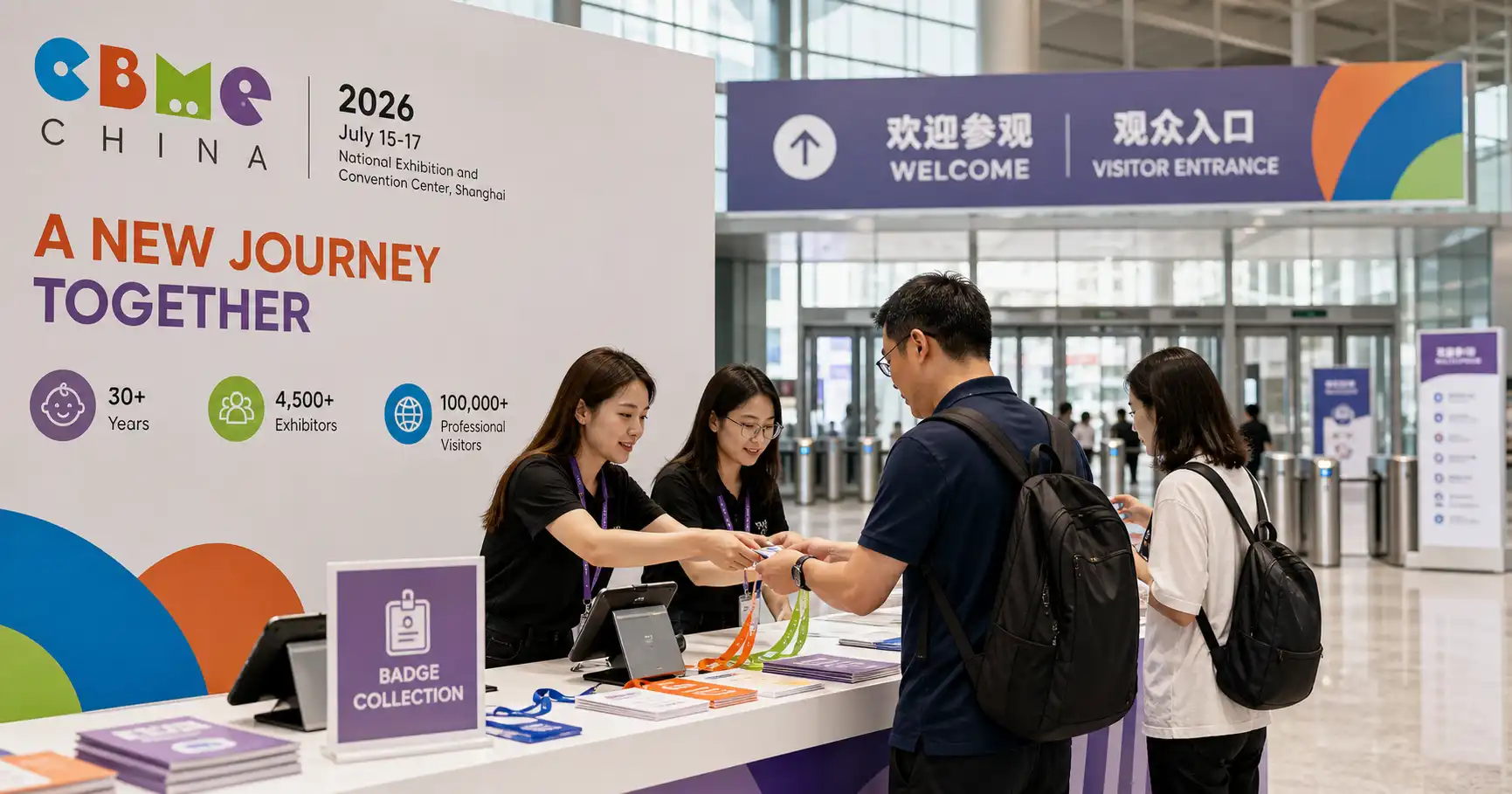
CBME China 2026 at a Glance
- Date: July 15–17, 2026
- Venue: National Exhibition and Convention Center (NECC), Shanghai
- Scale: 4,500+ brands | 3,200+ exhibitors | 100,000+ trade buyers | 300,000 m²
- Kidswear category share: 15.3% of exhibitor space
- Concurrent events: CBME Children’s Wear Expo | CBME Toy & Education Expo | CBME Food & Health Expo | CBME Supply Chain Expo | Licensing Expo China (LEC)
- Admission: RMB 100, waived with pre-registration
- Registration: Register online at CBME China official site
Why Children’s Footwear and Kidswear Are a Priority Category at CBME China 2026
Several structural factors make 2026 a meaningful sourcing window for international buyers of children’s footwear and apparel.

Scale and depth in one location
CBME China 2026 brings together 3,200+ exhibitors across the full baby and maternity product spectrum, including dedicated space for children’s shoes, children’s clothing, accessories, and baby home textiles (per the official CBME China 2026 hall layout). The event has held 25 editions since 2001, building a proven track record as Asia’s largest children’s products sourcing platform. For footwear and apparel buyers, a single Shanghai visit covers categories that would otherwise require multiple factory tours across Guangdong, Zhejiang, and Fujian.
Related: Baby Food and Infant Nutrition Suppliers in China (Day 16) and Children’s Wear and Baby Clothing Manufacturers in China (Day 22) provide parallel category coverage to pair with this guide.
The Children’s Wear Expo runs concurrently
CBME Children’s Wear Expo is an official concurrent event within the CBME China 2026 programme, specifically focused on children’s wear, baby apparel, and children’s shoes — the category is explicitly named in the official CBME China 2026 hall layout. It runs alongside CBME Toy & Education Expo, CBME Food & Health Expo, CBME Supply Chain Expo, and Licensing Expo China (LEC), giving buyers an integrated view of the children’s product ecosystem without travelling between events.
IP and licensing is increasingly factory-level
The Licensing Expo China within CBME 2026 reflects a broader shift: Chinese children’s footwear and apparel manufacturers are building in-house design and licensed-IP capabilities to serve export markets. For buyers sourcing from China, this means you are increasingly dealing with factories that have moved beyond pure OEM — they can offer style development, trend forecasting, and IP documentation alongside production.
Sub-Category Map: What Footwear and Apparel Buyers Will Find at NECC Shanghai
Before planning your CBME 2026 visit, map the sub-categories covered across the Children’s Wear Expo and main CBME halls.

Footwear sub-segments
- Baby first shoes and soft-soled shoes (0–18 months) — designed for early walkers, often with flexible soles and breathable uppers
- Children’s casual shoes (toddler through size 30) — everyday wear including sandals, canvas shoes, and leather school styles
- Kids’ athletic and running shoes — lightweight sport-specific designs for active children
- Outdoor and hiking footwear — water-resistant, durable casual outdoor styles gaining traction among urban Chinese parents
- School shoes and dress shoes — formal and semi-formal styles for school-age children
- Custom/OEM children’s footwear — full tech-pack-driven production for brand owners and private-label buyers
Kidswear sub-segments
- Baby and infant apparel — bodysuits, rompers, sleepers, and layettes for newborns and infants
- Children’s casual wear — t-shirts, shorts, leggings, dresses, and sweaters for ages 2–12
- School uniforms and PE kits — durable, color-consistent uniform supply for institutional buyers
- Sportswear and activewear — performance fabrics and trend-driven athletic styles
- Outerwear and seasonal collections — jackets, snowsuits, and rainwear ordered 4–6 months ahead of season
- Licensed and character-driven apparel — IP-backed designs for sports brands, entertainment properties, and cultural collaborations
Trend 1: Comfort-First Footwear Design
The most consistent signal across Chinese children’s footwear manufacturers heading into 2026 is a shift toward comfort-first design. Parents — particularly in urban China — are increasingly prioritising anatomical foot development over pure aesthetics, driven in part by short-video platforms like Douyin, where children’s product recommendations and parenting content have driven rapid awareness of foot-health considerations in early childhood.
Factories investing in R&D are developing wider toe-box constructions, flexible thin soles that allow natural foot movement, and breathable upper materials such as knit mesh and organic cotton linings. The health-angle is not just marketing — it aligns with growing consumer awareness of foot development in early childhood, particularly for first-walker and toddler categories.
At CBME China 2026: Look for suppliers with dedicated comfort-lines or “foot-health” collections in the children’s footwear category. Ask to see material spec sheets for sole flexibility and upper breathability. Factories with in-house R&D investment are more likely to have documented performance data to share with export buyers.
Trend 2: Sustainable Materials Move into Children’s Footwear and Apparel
Sustainability is no longer a niche claim in Chinese children’s footwear and kidswear — it is becoming a baseline expectation for export-ready factories. Verified sustainable materials are appearing across all price tiers.
What buyers are seeing from Chinese factories:
- Organic cotton and bamboo-blend fabrics in kidswear uppers and linings
- Recycled EVA and rubber compounds in footwear soles
- Water-based adhesives replacing solvent-based glues in children’s shoe construction
- Biodegradable and minimal packaging for private-label orders
Certification context: The frameworks buyers most commonly ask about — OEKO-TEX Standard 100 (textile safety), REACH (EU chemical compliance), BSCI (factory social compliance), and ISO 9001 (quality management) — are widely available among export-oriented Chinese children’s footwear factories. However, certifications vary by supplier. The rule is simple: request the certificate, note the number and issuing body, and verify independently. Do not accept verbal assurance.
At CBME China 2026: The CBME Supply Chain Expo (a concurrent event) includes materials suppliers who support sustainable children’s footwear and apparel production. Planning a circuit through the Supply Chain Expo gives buyers with sustainability requirements a direct view of which factories have invested in verified sustainable supply chains.
Trend 3: Outdoor and Active Footwear for Children
The “outdoor kid” movement in China is generating measurable demand for children’s footwear designed for active use: lightweight hiking shoes, water-resistant casual outdoor styles, and sport-specific designs for cycling, running, and playground use.
This is a growth category with relatively few established Western brands dominating the market — creating an opening for private-label buyers and importers to build differentiated product lines from Chinese manufacturers.
Why it matters for sourcing: Outdoor footwear requires specific construction skills: durable lightweight soles, water-resistant upper bonding, and reinforced toe and heel areas. Not all children’s footwear factories have this capability. Identifying which suppliers have outdoor production experience — and asking for examples of their active or outdoor range — is a key qualifier for buyers in this category. Our trending analysis of kids sneakers and children’s footwear trends covers the athletic footwear angle in more detail.
At CBME China 2026: The children’s shoes sub-category within the Children’s Wear Expo is where outdoor-style footwear is most likely to be concentrated. Ask exhibitors specifically whether they produce outdoor or sport-specific children’s styles before investing time at a booth.
Trend 4: Licensed and Character-Driven Kidswear
Licensed and character-driven apparel remains one of the highest-growth segments in Chinese children’s wear, driven by sports licensing cycles, entertainment IP partnerships, and cultural collaborations — a dynamic that CBME China’s Industry Insights editorial has tracked across multiple show cycles.
For buyers sourcing licensed production from China, the critical issue is documentation — not just the style itself.
What buyers need to verify: Chinese factories producing licensed children’s apparel and footwear for export markets should be able to provide the licensing chain documentation: the agreement between the brand or IP holder and the factory, or between the brand and a licensed agent who then contracts the factory. Without this chain, buyers can face customs holds, intellectual property disputes, or market-entry rejections — particularly in the EU and US.
At CBME China 2026: Licensing Expo China (LEC) provides a venue where IP holders, licensing agents, and factories are all present. For buyers sourcing licensed children’s footwear or apparel, LEC is a useful reference point for understanding which Chinese factories have active, documented licensing arrangements.
How to Discover These Trends at CBME China 2026

CBME China offers several tools specifically designed to help buyers shortlist exhibitors before arriving in Shanghai.
Before the show
The monthly CBME China Product Spotlight (available on the official website) previews exhibiting suppliers by category, including children’s footwear and kidswear. Buyers who use the Product Spotlight before the show typically arrive with a shortlist of 10–15 target booths rather than walking the full 300,000 m² without a plan.
The Hosted Buyer Programme connects qualified buyers with pre-scheduled 1-on-1 appointments with verified manufacturers before the show opens. Manufacturing Buyer registration is open now.
At the show
Dedicated halls for Baby & Kids Wear, Shoes and Accessories at NECC Shanghai make focused navigation efficient. Children’s shoes and kidswear are explicitly named in the official CBME China 2026 hall layout. Conference and forum sessions often include trend panels and market update presentations relevant to footwear and apparel buyers.
After the show
Buying decisions are rarely closed on the show floor. The standard follow-up workflow is: shortlist 5–8 suppliers during the three-day event, request samples within two weeks of returning, and move to bulk quotation for the top 3 within 30 days.
Questions Buyers Should Bring to Children’s Shoe and Kidswear Suppliers
A focused set of questions separates prepared buyers from casual browsers. Use this checklist at every footwear and kidswear booth you visit.
Product and capability questions
- Do you offer OEM or ODM services for children’s footwear or kidswear?
- What sub-categories do you specialise in — casual, athletic, outdoor, school, or licensed?
- What is your minimum order quantity per style per colorway?
- What is your production lead time from sample approval to bulk delivery?
Material and compliance questions
- Can you provide OEKO-TEX, REACH, CPSIA, or equivalent certifications for the materials you use?
- Do you hold any sustainability certifications such as GOTS (for organic cotton) or GRS (for recycled materials)?
- Where are your mills and component suppliers located — can you document the full supply chain?
Licensing and IP questions
- Do you have an active licensing agreement or chain-of-custody documentation for the IP designs you are showing?
- Can you provide documentation that covers the specific markets you will be shipping to?
Sample and follow-up questions
- Do you charge for samples, and are sample costs deducted from bulk orders?
- Do you offer pre-production samples (PPS) before bulk run approval?
- What are your payment terms for first orders versus repeat orders?
Frequently Asked Questions
What is the typical MOQ for children’s shoes from Chinese suppliers?
Most Chinese children’s footwear manufacturers accept minimum order quantities in the 300–1,000 pairs per style per colorway range for first orders, though the exact figure depends on design complexity and materials. Simple styles such as soft-soled baby shoes or basic slippers may start as low as 300 pairs; athletic or outdoor children’s footwear with custom midsoles often require 1,000+ pairs. Many factories offer reduced first-order MOQs for qualified buyers — this is worth discussing directly with each supplier. Always confirm MOQ before adding a factory to your shortlist.
Do children’s shoe manufacturers in China meet international safety standards?
Many established Chinese children’s footwear factories hold OEKO-TEX Standard 100 (for textile and leather components), REACH compliance documentation (for EU markets), CPSIA compliance (for US market entry), and BSCI or ISO 9001 certifications for factory operations. However, certifications vary by supplier — a factory’s claims should always be verified independently against the issuing body’s registry. At CBME China 2026, exhibitors frequently display certification documentation at their booths. Use this as a starting point for verification, not as the final check.
How do I source sustainable children’s footwear at CBME China?
Several CBME exhibitors now specialise in sustainable children’s footwear options, offering recycled material soles, organic cotton uppers, and water-based construction. Ask specifically for material spec sheets and chain-of-custody documentation (for example, GOTS certificates for organic cotton or GRS certificates for recycled content). The CBME Supply Chain Expo — a concurrent event within CBME China 2026 — features materials suppliers who support sustainable children’s footwear production. Visiting this section gives buyers with sustainability requirements a direct view of which factories have invested in verified sustainable supply chains.
Can Chinese children’s footwear manufacturers produce licensed or IP-driven apparel?
Yes — many Chinese factories have developed licensed production capabilities specifically for export markets. When sourcing IP-driven children’s apparel or footwear, the critical requirement is documentation: ask to see the licensing agreement or chain-of-custody documentation that authorises the factory to produce designs for specific IP holders and target markets. Factories that cannot produce this documentation should not be used for licensed production regardless of price. The Licensing Expo China (LEC) within CBME China 2026 provides a venue for verifying which Chinese factories have active, documented licensing arrangements.
How does CBME Children’s Wear Expo help footwear and apparel buyers?
CBME Children’s Wear Expo is an official concurrent event within CBME China 2026, dedicated to children’s wear, baby apparel, and children’s shoes — explicitly named in the official hall layout. It runs alongside the main CBME exhibition halls at NECC Shanghai, giving footwear and apparel buyers a concentrated environment to compare suppliers across sub-categories, from baby soft-soled shoes and infant apparel to licensed children’s wear and school uniform suppliers. Combined with the main CBME halls, the event covers the full children’s footwear and kidswear sourcing spectrum in a single venue.
What should I prepare before visiting CBME China 2026 for kidswear sourcing?
Prepare a target-supplier brief covering your desired sub-categories, estimated order volumes per SKU, required certification standards for your target market, and any IP or branding requirements. Download the monthly CBME Product Spotlight before the show to flag exhibitors in your category. Apply for the Hosted Buyer Programme if you want pre-scheduled appointments with verified manufacturers. Arrive with a clear evaluation scorecard — most buyers use a combination of product range, certification documentation, sample availability, and lead-time报价 to rank suppliers during the three-day visit.
Explore Related Articles
- Baby Food and Infant Nutrition Suppliers in China (Day 16) — the parallel category trends guide covering food and nutrition sourcing
- Children’s Wear and Baby Clothing Manufacturers in China (Day 22) — apparel-focused companion guide to pair with this footwear article
- Toy and Educational Product Manufacturers in China (Day 24) — fellow Children’s Wear Expo concurrent category for comprehensive show planning
- Kidswear and Children’s Shoes Trends from CBME China 2026 (Day 48, post-show) — follow-up trends recap after the event
- China Baby and Maternity Market Guide 2026 (Day 11) — broad market context for the children’s products sector
- China Mother and Baby Consumer Trends 2026 (Day 53) — consumer demand signals driving kidswear and footwear purchasing decisions
Official Sources
- CBME China About — Event dates, venue, exhibition profile, hall layout, 25 editions since 2001
- CBME China Why Visit — Category breakdown (15.3% Baby & kids wear, shoes and accessories), scale claims, visitor value proposition, admission (RMB 100, waived with pre-registration)
- CBME China Product Spotlight — Monthly previews of exhibiting suppliers
- CBME China Hosted Buyer Programme — 1-on-1 pre-scheduled appointments with verified manufacturers
- CBME China Industry Insights — Industry trend editorial coverage (referenced as directional trend context only)
Publisher and Editorial Information
Published by CBME China Editorial Team, a division of Informa
Questions about this article? Contact the CBME China editorial team
Last reviewed: July 2, 2026 | First published: July 2, 2026 | Publisher: CBME China, a division of Informa
Ready to walk the children’s footwear and kidswear halls at CBME China 2026?
Register to visit CBME China (July 15–17, NECC Shanghai) — admission is RMB 100 and waived with pre-registration. Use the monthly CBME Product Spotlight to shortlist exhibitors before you arrive.