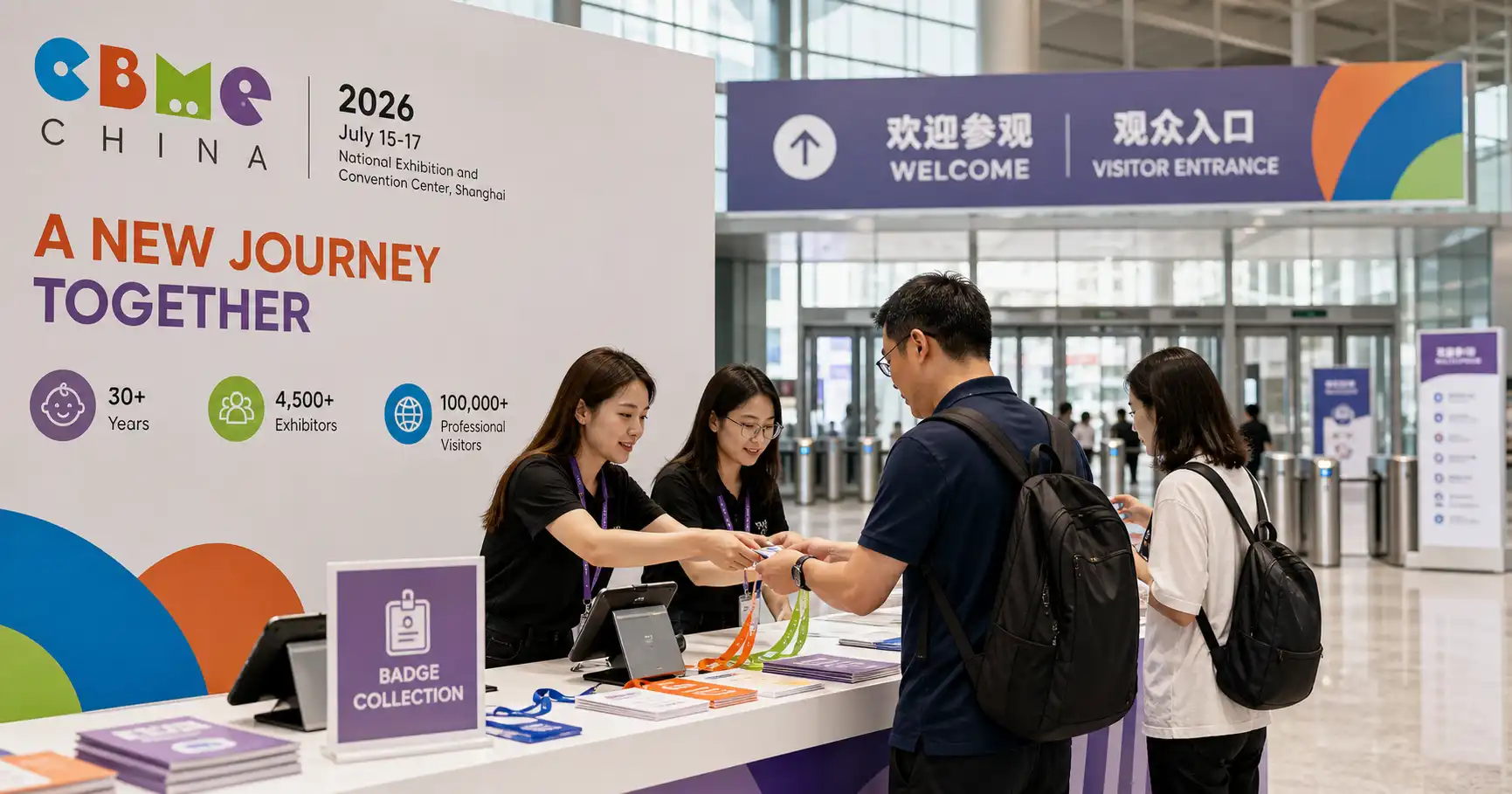
Reliable baby product suppliers in China are not the ones with the best booth — they are the ones whose certificates, capacity, and commercial terms survive a structured evaluation. With 3,200+ exhibitors, 4,500+ brands, and 100,000+ trade buyers gathering at the National Exhibition and Convention Center (NECC) in Shanghai from July 15 to 17, 2026, CBME China is the single largest baby product sourcing fair in Asia and the most efficient place to apply that evaluation at scale.
This guide gives international buyers a five-pillar reliability scorecard, a pre-show shortlist workflow built around the official CBME Product Spotlight, and a checklist of what to verify in the booth and after the show.

CBME China 2026
- Date: July 15–17, 2026
- Venue: National Exhibition and Convention Center (NECC), Shanghai, China
- Scale: 4,500+ brands, 3,200+ exhibitors, 100,000+ trade buyers, ~300,000 m²
- Product Categories: Mother & baby care (35.2%), Food/nutrition (21.0%), Strollers/car seats/furniture (17.9%), Kids wear/shoes (15.3%), Toys/stationery/education (10.7%), Supply Chain
- 2026 Theme: Comprehensive · Efficient · Innovative · Trend-driven
- Key Resources: Monthly Product Spotlight PDF · Hosted Buyer Program (closed for 2026) · Standard visitor pre-registration
- Register: Register free — waive RMB 100 walk-in fee
Why Reliability Is the Hardest Filter at a China Baby Product Sourcing Fair
China’s baby product manufacturing base is one of the deepest in the world. Industrial clusters in Guangdong, Zhejiang, Jiangsu, and Shanghai produce the majority of the global supply for strollers, car seats, infant skincare, baby clothing, nursery furniture, toys, and infant nutrition. For buyers, that depth is the main reason to attend CBME China — it compresses weeks of factory outreach into a three-day, walk-the-floor visit.
But the same depth makes reliability hard to filter by instinct. Two adjacent booths may both claim to manufacture the same product category. One is an OEM with twelve years of export history to the EU; the other is a trading company reselling products from a third-party factory. Both can hand you a glossy catalogue. Neither will volunteer the difference.
The 2026 sourcing environment makes this harder. Two new regulatory requirements have come into effect that affect every shipment:
- China Customs Announcement No. 57 of 2026 (effective June 1, 2026). The General Administration of Customs now runs annual random spot-checks on baby product exports outside the statutory inspection catalogue. For affected categories, sampling and testing must complete at the factory or warehouse before a customs declaration is filed. Industry reporting indicates this adds a 7–10 day inspection window that buyers should build into production and shipping schedules.
- CPSC eFiling (effective July 8, 2026). For US-bound shipments, the Consumer Product Safety Commission requires electronic submission of Children’s Product Certificates (CPCs). Your supplier’s third-party test report, issued by a CPSC-accepted laboratory, must be filed with all seven required CPC elements documented in English.
These changes expose the difference between a reliable baby product supplier in China and one that simply looks reliable in a booth. A practical way to filter is to use a 5-pillar scorecard before, during, and after the show. The rest of this article walks through each pillar with the specific checks a buyer can run before placing an order. The broader end-to-end sourcing workflow — from defining scope to follow-up — is mapped in our companion guide, How to Source Baby Products from China: A Guide for Global Buyers.
Pillar 1: Compliance and Certification — The First Filter
Compliance is the only pillar where the answer can be yes-or-no in writing. Ask any potential supplier for current, verifiable certificates and check the certificate number against the issuing body. Photos are not enough.
The baseline certificates to request from a Chinese baby product supplier are:
- ISO 9001:2015 — Quality management systems. The minimum standard for any export factory.
- ISO 13485:2016 — Medical device quality management. Required for products bordering on medical devices (infant monitors, feeding devices). Verify the scope explicitly covers your product category.
- CE Mark (EU 2017/745) — Required for European Union market access. Confirm the Notified Body number.
- CPSC-accepted third-party test report — Required for US-bound products. The lab must be on the CPSC-accepted list; factory-internal tests are not accepted.
- FDA Registration — Required for US-bound feeding, skincare, and certain nutrition products.
- BSCI or SEDEX — Social compliance audits increasingly required by European retail chains.
- FSC Certification — Chain-of-custody for paper and pulp-based packaging, required by growing numbers of EU and North American retailers.
For a deeper walkthrough of how 2026 regulatory changes affect sourcing and what to request from any baby product supplier in China, see the compliance section of our How to Source Baby Products from China guide.
Pillar 2: Production Capacity and Export Track Record
A certificate proves the factory has a system. Capacity proves the factory can run your order. Three practical checks:
- Annual production volume in your category. A factory that produces 200,000 strollers a year is not the same risk as one that produces 20,000. Ask for the past twelve months’ output and the percentage currently exported.
- Reference buyers in your target market. Reliable suppliers will share two or three export references. A refusal to share references is itself a signal.
- Recent export documentation. A commercial invoice, packing list, or bill of lading from a comparable shipment tells you the supplier is actively shipping, not just claiming capability.
A trade fair is one of the few places you can ask to see export documents in person and verify that the name on the document matches the supplier in the booth. The 2026 customs spot-check regime makes this verification more important than it has been in past years. The broader end-to-end approach to choosing between real manufacturers and trading companies is covered separately in How to Source Baby Products from China.
Pillar 3: Communication, Samples, and Lead Time
A reliable supplier in China responds the way a reliable supplier in any market does: clearly, quickly, and with specifics. Three things to test in the four weeks before the show:
- Reply time. A first enquiry email should get a substantive response within 24–48 hours. Slower usually means slower during production as well.
- Sample policy. Ask for a paid sample shipped by courier. The willingness to ship a sample quickly — and the accuracy of the lead time they quote — is the most reliable predictor of how they will behave at scale.
- English fluency of the account manager. If you cannot get a clear answer in writing before the show, you will not get one on the booth or during production.
If you are planning your first sourcing trip, see the broader context for how the three show days support serious supplier meetings in How to Source Baby Products from China.
Explore CBME Product Spotlight
Pillar 4: Customisation, Packaging, and Private-Label Readiness
If you are evaluating a Chinese baby product supplier for a private-label or OEM line, this is where most of the operational risk lives. Three signals matter:
- Dieline and print specifications. A supplier ready for private label will share a dieline, print spec, and Pantone reference on request. A trading company often cannot.
- Sample mock-ups with your brand. Ask for a printed sample, not just a generic product sample. The willingness to invest the time in a branded mock-up is a strong signal of capability.
- Packaging compliance for your market. Packaging requirements differ sharply by market. EU requires specific recycling marks; US requires specific tracking labels. Reliable suppliers confirm compliance in writing and provide market-specific artwork files.
Pillar 5: Cost, MOQ, and Payment Terms — The Last Filter
Cost is the last pillar, not the first, for a reason. A low unit price from an unreliable supplier is more expensive than a higher price from a reliable one. Once a supplier clears pillars 1–4, the cost question is the final qualification.
Three things to confirm in writing before placing an order:
- Pricing structure. A reliable supplier provides a quote broken down by unit price (FOB or CIF, stated clearly), tooling cost, sample cost, and packaging cost. Be cautious of single-line “all-in” quotes.
- MOQ per SKU. MOQ varies widely by category. Ask for the MOQ per SKU, per colour, and per size — not the headline figure.
- Payment terms. Standard industry terms are 30% deposit + 70% balance against a copy of the bill of lading. Avoid suppliers who require 100% upfront for a first order.
Use the Hosted Buyer Program to Pre-Qualify Baby Product Suppliers in China
CBME China’s Hosted Buyer Program is the most efficient pre-qualification channel for international buyers. The programme provides a customised supplier shortlist, pre-scheduled 1-on-1 meetings, and post-event follow-up support.
Key programme benefits per the official page (source: CBME China Hosted Buyer Program):
- Pre-scheduled 1-on-1 meetings with your ideal suppliers
- A customised supplier shortlist based on your product category and order volume
- Post-event follow-up service and year-round matchmaking
- Twin sharing hotel room for 2 nights
- Fast and free access to the venue
- 2-day lunch and exclusive service at the EVIP lounge
- Exclusive gift and free show catalogue
Eligibility, also per the official page, considers three criteria:
- You have decision-making authority for baby or maternity purchasing
- You have purchasing needs in the next 6–18 months
- You are willing to meet at least 6 exhibitors during the show
The 2026 Hosted Buyer Program application window closed on 30 May 2026. The programme remains a useful reference for buyers planning their 2027 sourcing calendar, and buyers who missed the 2026 deadline can still register as standard visitors to access the show floor, the Product Spotlight, and the full 3,200-exhibitor directory.
Build a Pre-Show Supplier Shortlist with the Product Spotlight
The most efficient way to walk into CBME China 2026 with a reliable shortlist is to combine the official Product Spotlight with the CBME exhibitor directory. The Product Spotlight is a monthly PDF curated by the CBME team, with the most recent issue referenced on the official site being the May 2026 edition (issue #2). The Spotlight page describes a clear three-stage workflow:
Before the exhibition
- Review the monthly selections and flag products aligned with your sourcing goals and target market
- Visit featured suppliers’ profiles on the CBME China website to explore their full product range and capabilities
- Use the Hosted Buyer Program Matchmaking Service to arrange 1-on-1 appointments with exhibitors of interest
- Develop specific questions on customization, pricing tiers, lead times, and partnership terms
During the exhibition
- Use the curated list to navigate the show floor efficiently
- Compare competing products and negotiate from an informed position
After the exhibition
- Reconnect with priority suppliers using insights gathered from the Spotlight and booth visits
- Access the Hosted Buyer Program’s ongoing matchmaking for continued supplier relationship development
Onsite Evaluation: 12 Questions to Ask at the Booth
Once you arrive at the NECC, every meeting should answer a fixed question set so you can compare suppliers objectively. Twelve questions to keep on your scorecard:
Compliance
- Can you share your current ISO 9001:2015 certificate, and which body issued it?
- For US-bound products: which CPSC-accepted third-party laboratory do you use, and can I see a recent test report?
- For EU-bound products: which Notified Body issued your CE certificate, and is the scope statement aligned to my product category?
Capacity
- What was your production volume in my product category over the past twelve months?
- What percentage of your output is currently exported, and to which top three markets?
- Can you share two reference buyers in my target market, ideally one in a comparable regulatory environment?
Communication & samples
- What is your standard sample policy — paid or free, sample lead time, and courier preference?
- Who will be my day-to-day account contact, and what is their English fluency level?
Customisation
- What is the MOQ per SKU, per colour, and per size for my product?
- Can you share a dieline, Pantone reference, and market-specific artwork template for the packaging?
Commercial
- Can you provide a written quote broken down by unit price (FOB or CIF), tooling, sample, and packaging?
- What are your standard payment terms, and what does your production lead time look like for a first order of my size?
After the Show: Verifying Certificates, Converting Quotes to Orders
A reliable supplier in China is one whose paperwork is verifiable. Before converting a show-floor conversation into a purchase order, run four final checks:
- Verify each certificate number independently with the issuing body. ISO, CE Notified Body, FDA registration, and CPSC-accepted labs all have searchable databases.
- Request a pre-production sample with your market’s compliance documentation attached. Do not commit tooling until the sample passes your quality check.
- Lock the production schedule with the 2026 customs spot-check window in mind. Build 7–10 extra days into your timeline for factory or warehouse inspection on affected categories.
- Confirm payment terms in writing, including the deposit percentage, the balance trigger (typically a copy of the bill of lading), and the currency.
CBME China 2026: At a Glance
- Event: CBME China 2026 — International Maternity, Baby & Child Expo (25th edition)
- Dates: July 15–17, 2026
- Venue: National Exhibition and Convention Center (NECC), Shanghai
- Scale: 4,500+ brands · 3,200+ exhibitors · 100,000+ trade buyers · nearly 300,000 m²
- 2026 Theme: Comprehensive · Efficient · Innovative · Trend-driven
- Product Categories: Mother & baby care 35.2% · Food/nutraceuticals 21.0% · Strollers/car seats/furniture 17.9% · Kids wear/shoes 15.3% · Toys/stationery/education 10.7% · Supply Chain
- Pre-Show Resources: Product Spotlight (monthly PDF) · Hosted Buyer Program (closed for 2026)
- Pre-Registration: Waives RMB 100 walk-in admission fee; VIP fast-track entry
Frequently Asked Questions
How do I find reliable baby product suppliers in China before CBME China 2026?
The most efficient pre-show workflow is to use the CBME Product Spotlight to shortlist exhibitors by product category, then verify each shortlisted company’s profile on the official CBME China website for export history, certifications, and production capabilities. Combine this with the Hosted Buyer Program (closed for 2026, reopens for 2027) if your purchasing needs match the eligibility criteria.
What is the best way to evaluate a Chinese baby product supplier at the show?
Use a 5-pillar scorecard — compliance and certification, production capacity and export track record, communication and sample policy, customisation and packaging readiness, and cost/MOQ/payment terms. Run the same 12 questions on every shortlisted supplier so you can compare answers objectively.
Do I need to verify a Chinese supplier’s certificates myself?
Yes. Request the original certificate (not a photo), confirm the certificate number directly with the issuing body, and check that the scope statement on the certificate covers your product category. For US-bound products, verify the testing laboratory on the CPSC-accepted list. For EU-bound products, confirm the Notified Body number on the relevant EU database.
What is the difference between an OEM, ODM, and trading company in China?
OEM (Original Equipment Manufacturer) means the factory manufactures to your proprietary design. ODM (Original Design Manufacturer) means the factory supplies a ready-made design that you private-label or customise. A trading company resells products from a third-party factory and adds a margin without manufacturing capability. Reliability differs sharply across the three.
Can I attend CBME China 2026 even if I missed the Hosted Buyer Program deadline?
Yes. Pre-registration for standard visitor admission remains open. Pre-registered visitors waive the RMB 100 walk-in admission fee, receive VIP fast-track entry, and gain access to the Product Spotlight, exhibitor directory, and the full 3,200+ exhibitor show floor. The Hosted Buyer Program 2026 application window closed on 30 May 2026; the programme reopens for 2027 sourcing planning.
How does the 2026 customs spot-check policy affect my baby product shipments from China?
China Customs Announcement No. 57 of 2026 (effective June 1, 2026) introduced annual random spot-checks on baby product exports outside the statutory inspection catalogue. Affected products must complete factory or warehouse sampling and testing before a customs declaration can be filed. Industry reporting indicates a 7–10 day inspection window should be built into production and shipping schedules. Confirm with your supplier whether your product category is covered and that the factory has the documentation to pass a spot-check without delay.
Continue reading: How to Source Baby Products from China: A Guide for Global Buyers • Why CBME China 2026 Is a Must-Visit Baby and Maternity Expo in Asia
Official Sources
- CBME China — Why Visit (source: CBME China official site)
- CBME China — Product Spotlight (source: CBME China official site)
- CBME China — Hosted Buyer Program (source: CBME China official site)
- CBME China — About (source: CBME China official site)
- Consumer Product Safety Commission — Children’s Product Certificate (source: CPSC.gov official site)
- General Administration of Customs of the People’s Republic of China — Announcement No. 57 of 2026 (source: General Administration of Customs PRC official site)
Published by CBME China Editorial Team
Content is reviewed by the CBME China editorial team before publication. To report a factual error or request an update, message the editorial team via WhatsApp.
Last reviewed: June 14, 2026 | First published: June 14, 2026 | Publisher: CBME China, a division of Informa